“Five centimeters per second”
5 Centimeters per Second“Five centimeters per second” is first Akari Shinohara’s answer to a question about falling cherry blossoms, but the expression grows beyond its simple measurement. Repeated across childhood, separation, reunion, and adulthood, it binds particular scenes together: petals drifting over a road, a letter about a tree, rain turning to snow, and an adult stopping beneath another cherry tree. Its steady return gives distance a delicate, perceptible scale without suggesting that memory can undo it.
Origin and Meaning
The phrase enters the story during spring, when Akari and Takaki Tohno are sixth graders walking home with their backpacks. They pass a small forest where cherry trees are in full bloom. Petals descend onto the asphalt until it looks white; the air is warm, the sky pale blue, and birdsong is clearer than the nearby highway or railway. In this quiet scene, Akari remarks that the blossoms look almost like snow, then offers the falling speed as five centimeters per second.
Her explanation turns an ordinary sight into a small lesson, but its effect on Takaki is not merely informational. He finds the words mysterious and is impressed that she knows them. Akari continues with other speeds: rain falls at five meters per second, while clouds move at one centimeter per second. The conversation thus gives the phrase a place in a miniature vocabulary of natural motion, while the cherry blossoms make it personal. It belongs to a moment shared between the two children, and to the attention they give the same landscape.
The number’s precision contrasts with the scene’s softness. The petals seem to fall almost silently, and the phrase measures their movement without exhausting what Takaki notices in it. That gap between a calculable speed and an emotionally charged image helps the expression endure: it can be recalled exactly, even as the childhood moment it names recedes into the past.
A Phrase Carried Across Distance
After Akari moves away, she and Takaki begin exchanging letters about once a month. Her descriptions of middle-school life include a train ride, basketball, and the decision to cut her hair; their correspondence gives each a sense of being understood even when they do not meet. In one letter, Akari writes that she wants to see cherry blossoms with Takaki again and mentions a large tree near her home. She imagines that its petals fall at five centimeters per second, carrying their earlier conversation into a new place and a later stage of their lives.
The recurrence makes the phrase part of their correspondence without turning the letters into a simple promise that distance will be overcome. Takaki learns that his move to Kagoshima will place him much farther from Akari, and that meeting again may no longer be practical. Against that change, her reference to the blossom speed preserves a shared point of attention. The words can travel where the children cannot easily go together: from one remembered spring to a tree she has seen near her home, and from her letter into Takaki’s imagination.
On the day Takaki travels to meet her, rain falls from morning onward. At school, he watches it and remembers the measure Akari gave for rain: five meters per second. As the drops grow larger, the rain turns to snow. The episode brings the two speeds into the same stretch of experience, linking the phrase’s original explanation to the weather of their long-awaited meeting. The measurement remains simple; the conditions around it change from classroom rain to falling snow and from anticipation to an actual reunion.
Snow, Blossoms, and Reunion
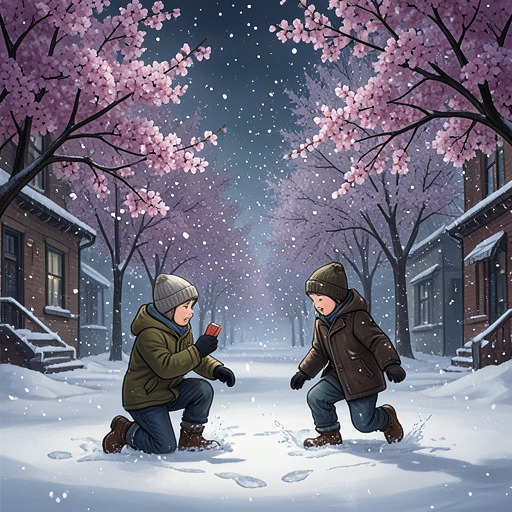
Akari takes Takaki to the cherry tree she had described in her letter. A ten-minute walk from the station leads them into open farmland, where there are no houses or artificial lights and the snowy landscape is faintly visible. The tree stands alone beside a path between rice paddies. Snow falls through its branches against a dark sky, making the scene resemble the snowy image associated with the expression from childhood, while also reversing the seasons of their first conversation: now it is snow, not petals, descending around them.
Akari repeats that the falling blossoms look almost like snow. Takaki answers that they do, and recalls the feeling that he has seen her watching him beneath a blooming cherry tree. The familiar comparison now joins two moments that are not identical: the sixth-grade walk and this nighttime meeting. The words bridge them while leaving the passage of time visible. That night, Akari and Takaki share their first kiss. The phrase is not itself a declaration, but its return accompanies a reunion in which their remembered intimacy becomes present physical closeness.
Adult Recollection and Narrative Significance
Much later, after leaving his company job, Takaki walks through residential streets and reaches a railroad crossing. A large cherry tree stands beside it, and fallen blossoms whiten the asphalt. Watching the petals drift, he thinks of their speed: five centimeters per second. The scene recalls the opening image through its tree, white ground, and spring air, but Takaki is now alone. The crossing alarm sounds as a woman approaches; they pass one another in its center. The moment ends with the phrase as a private recollection, not with an explanation of who the woman is.
Across these returns, the expression changes function without changing its words. First it is Akari’s piece of knowledge, then a detail carried into a letter, then part of Takaki’s anticipation and memory, and finally an inward thought prompted by blossoms beside a crossing. Its recurrence gives the narrative a compact thread through childhood affection, geographical separation, reunion, and adult solitude. The measured fall of petals is slow enough to notice but cannot hold them in place; similarly, the phrase preserves the trace of shared experience without reversing the time and distance that have separated the people who first spoke it.